
5 Best Walks in Edinburgh
Edinburgh is a bustling city of roughly half a million inhabitants with World renowned historical and cultural attractions. However, something that sets Edinburgh apart from most capitals is its sheer abundance of green space, even in the heart of the city. Combine this with hilly terrain, fantastic viewpoints, ever changing, unique neighbourhoods with historic landmarks and it makes Edinburgh a fantastic place to walk around. There are some excellent walks you can do in the city which can leave the curious traveler with a better sense of what makes Edinburgh so special and even (for those in the country for only a short while) a taste of the gorgeous Scottish countryside. Here are some of my favourites.
1. Arthur’s Seat/Holyrood Park
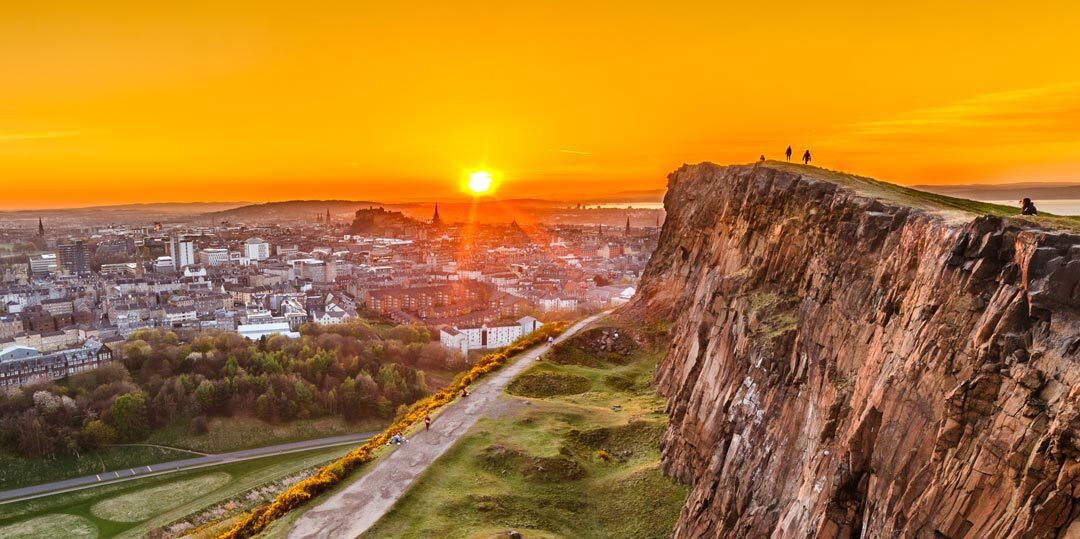
Towering over Holyrood Palace and the Old Town of Edinburgh itself is Arthur’s Seat, a 251 metre (823 feet) high volcanic plug (thankfully long since extinct. The curious name either relates to the mythical ruler of Britain King Arthur or is an anglicization of the Gaelic Àrd-na-Said which means “Height of Arrows”. There are easy paths leading to the summit (on average the ascent takes roughly 45-60 minutes) and absolutely unrivalled views of Edinburgh and the surrounding landscape. You can see across the Firth of Forth to the county of Fife, the Forth Bridges, the coastal plain of East Lothian and the Pentland Hills. If you are considering doing this walk while in town save it for a fine, clear day (we do have them in Scotland) so you can make the most of the views and have a safer, more enjoyable climb. Make sure you also have appropriate footwear as the summit is very rocky.
Arthur’s Seat lies within the boundaries of Holyrood Park which is a remarkably unspoilt area of wild, rugged beauty in the heart of Edinburgh. This former hunting park is home to medieval religious sites, 3 lochs, a former hill fort, tell-tale geological signs of glacial activity from the last Ice Age and is well worth taking a few hours to explore. We also offer tours to the summit of Arthur’s Seat and through Holyrood Park, you can buy tickets and find out more about them here. Your friendly, knowledgeable and professional guide will lead you up the hill (along the safest and least strenuous route) and talk you through the very distinctive geological, natural and historical sites you will encounter. For more general information about Holyrood Park click here.
Effort Level: Medium to High (depends on which route you take).
2. Calton Hill
If your free day in Edinburgh is unfortunately very windy, or you don’t feel able to make it to the summit of Arthur’s Seat, Calton Hill is another great option. Calton Hill lies immediately to the east of Princes Street – the main shopping street in Edinburgh so it’s easy to get to. You can access the paths up and around the hill from Waterloo Bridge, from there it is only a ten-minute walk straight to the top but the views are incredible! From the northern side you can see Leith (Edinburgh’s traditional port), the Firth of Forth and beyond that Fife. To the south you can gaze upon a tremendous panorama which includes the Old Town, Arthur’s Seat and the Pentland Hills beyond. For the best views and the most balanced walk start by taking the left most path and circle around the north side first before crossing to the southern side. This path is known as Hume walk because it was the route the great philosopher – David Hume – took on his daily stroll.
As well as brilliant views Calton Hill is packed with interesting history and grand monuments. The area was designated a public space by Edinburgh Burgh Council in 1724, making it one of the oldest public parks in the World. At the summit of the hill is Edinburgh’s former observatory (now an art collective and café), the high, telescope shaped tower built in honour of British naval hero Admiral Nelson and what seems to be the remains of a Greco-Roman temple. Surprisingly these columns are only two hundred rather than two thousand years old, they were erected as part of a plan to construct a mock Parthenon on Calton Hill as a monument to Scotland’s dead during the Napoleonic Wars. However not enough money was raised in charitable donation and the partially completed monument became known as “Edinburgh’s disgrace”.
You can visit Calton Hill, be informed of the best places to take pictures and learn more about its history on our Edinburgh’s Hidden Treasures Tour.
Effort Level: Low.
3. Water of Leith Walk
Unusually Edinburgh is a city without a major river, the main reason a settlement developed here originally was the very defensible site of Castlehill, but the so-called Water of Leith flows through the northern side of the city. The Water of Leith flows from the Penland Hills and out into the North Sea at the Port of Leith itself and is roughly 24 miles long. Visitors to Edinburgh can walk along the Water of Leith Walkway which follows the river for 13 miles from Balerno to the Port of Leith. The walkway takes in some very interesting and beautiful parts of Edinburgh, the village of Colinton (where Robert Louis Stevenson spend many a happy summer), Murrayfield Stadium, the Scottish National Gallery of Modern Art and Dean Village. With the decline of Leith as an industrial port from the 1980s, the river is once again home to a wide variety of wildlife, trout and salmon have been caught in the Water of Leith, herons and kingfishers are common sights on the banks and at certain times of day otters can be seen happily swimming by.
You can of course walk specific sections of the walkway if you only have an hour or two for your walk. A particularly fine stretch is just north of the New Town and goes from the National Modern Art Gallery to Stockbridge, and includes Dean Village. Dean Village is a former water mill village with buildings often dating back to the seventeenth century. I can strongly recommend doing this walk as part of a visit to the Gallery or a trip to the artistic neighbourhood of Stockbridge which has a fantastic food market every Sunday. You can visit Dean Village and learn more about this incredibly picturesque area on our Edinburgh’s Hidden Treasures Tour. There’s a map of the entire walkway which you can find here.
Effort Level: Low to Medium (Depends on how much of the walkway you cover).
4. Costorphine Hill
Just a few minutes’ walk from Edinburgh Zoo in the western suburbs of the city are the paths around and up Costorphine Hill, perfect on a nice day after visiting the pandas. At 531 feet (161 metres) the hill is relatively easy to ascend and is a pleasant woodland walk. Make sure you’ve got your camera ready for the “Rest and Be Thankful” viewpoint where the trees clear and you have an incredible view of the city. For geology and archeological fans there’s a lot to appreciate – across the hill are rocky granite outcrops indicated another volcanic plug and glacial activity. The top of the hill almost seems to have been scooped out by gigantic fingers which shows evidence of an Iron Age hillfort.
There are a few other hidden gems around the hill which you should endeavor not to miss. Local volunteers have recently and painstakingly restored a former walled garden on the hill which is open to the public and boasts a wide variety of flowers and wild plants in all seasons. Lurking in the midst of the woods is Clermiston Tower, which was erected to celebrate the centenary of Walter Scott’s birth in 1872. Funnily enough the tower is the colour the Scott Monument in the city centre should be. The Clermiston Tower is made of pink whinstone while the Scott Monument is made of pinkish sandstone but has been stained black by coal dust. You can find out more about Costorphine Hill on the Friends of Costorphine Hill website here.
Effort level: Low
5. Pentland Hills
To the immediate south of Edinburgh is the Pentland Hills Regional Park, the Pentlands are a range of 5 hills and offer visitors a taste of the Highlands within easy access of the city. There are a wide variety of routes you can take depending on your fitness level, some of the trails are low, even woodland walks but also strenuous hill walks. The Capital View Walk allows visitors a clear albeit exerting path to the top of the ridge but if you take the Glencorse View trail you will leave the city completely behind.
The Pentland Hills Park can be reached either through a short drive from the city centre (less than 30 minutes outside of rush hour) or via a 45-minute bus journey from Princes Street to Balerno – the 44 Lothian Buses route. The hills tend to be busier on the weekend so if you’d prefer a quieter walk go during the week. You can find out more about the Pentlands and the various walking routes you can take here.
Effort Level: Medium to High (Depends on which route you take).